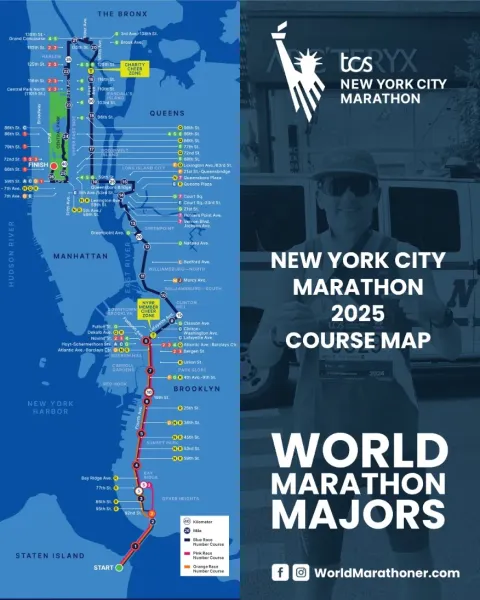

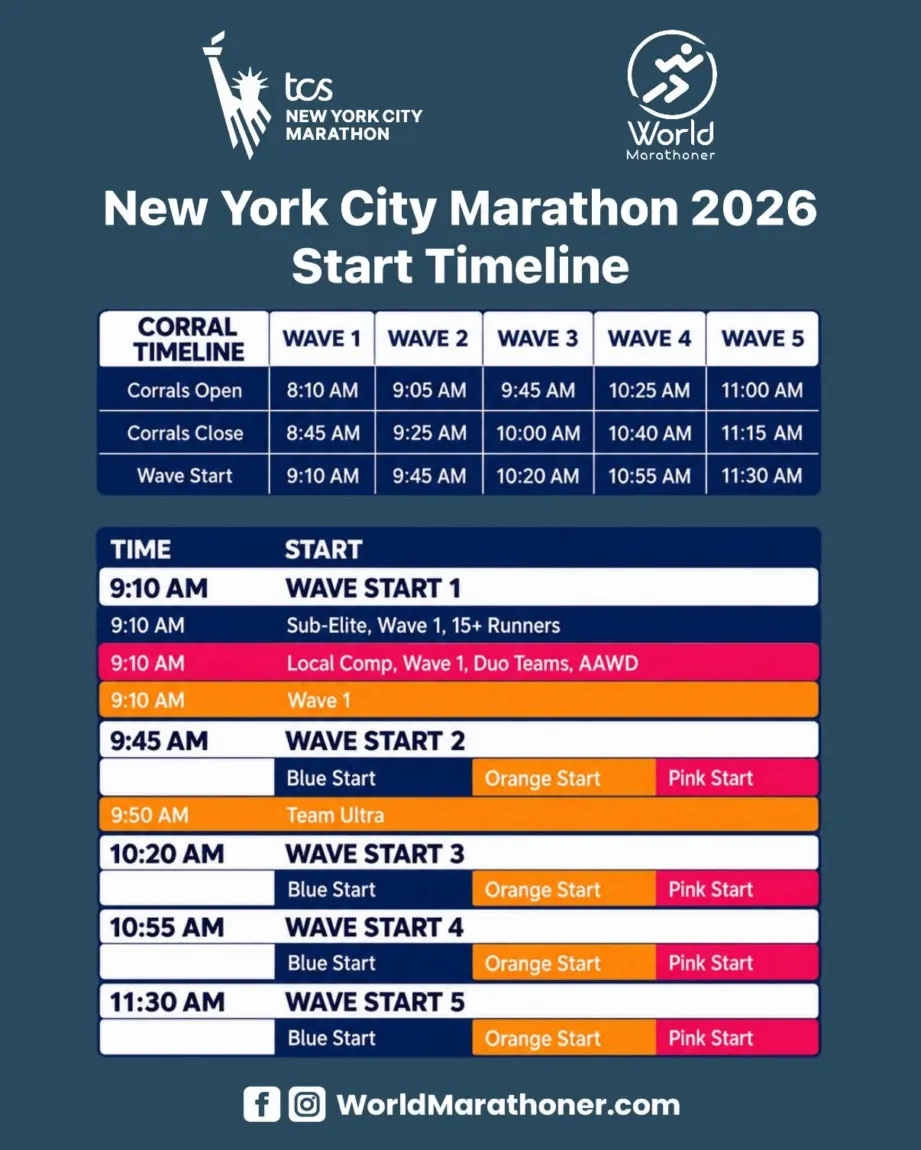
The TCS New York City Marathon 2026 will take place on Sunday, November 1. The race will begin on the Verrazzano-Narrows Bridge on Staten Island, with the course taking runners through Brooklyn, Queens, the Bronx and Manhattan before finishing in Central Park. This year’s edition will feature five start waves. The first wave will begin at 9:10 AM, and the final wave at 11:30 AM local New York time.
Before race day, runners should check three key details: when their corral opens, when it closes and when their wave is scheduled to start. A corral is a designated area where participants gather before the marathon begins. The colour of the assigned start area also matters, as Blue, Orange and Pink are located in different sections of the Verrazzano-Narrows Bridge.
The New York City Marathon was first held in 1970, when 127 runners took part. The original course looped around Central Park, before the route was extended across all five boroughs in 1976. The 2026 edition marks the 50th anniversary of that course. Below, you’ll find key information about the start arrangements, wave assignments and procedures for entering the start area.
Worth Reading!
Preparing for the marathon involves more than knowing your start time. Find out what running events take place during race week, explore the full course and see the medal designed for this year’s edition.
Shakeout Runs Before the New York City Marathon 2026
The Start on the Verrazzano-Narrows Bridge
The marathon start is divided into three colour-coded areas: Blue, Orange and Pink. Each is located in a different section of the Verrazzano-Narrows Bridge. The colour system helps organise the flow of participants and identifies where runners begin the race.
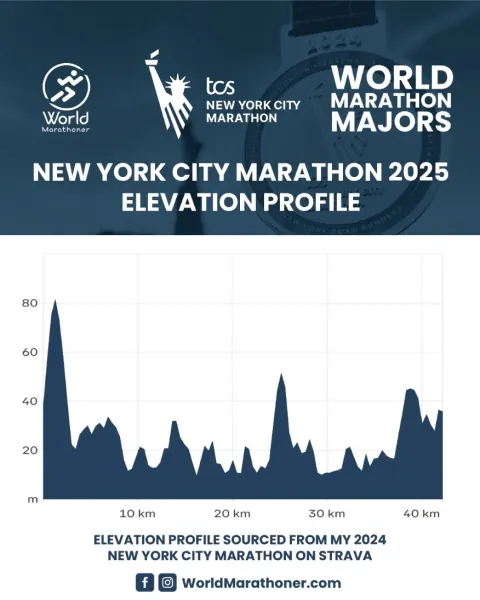
Blue is on the right side of the bridge’s upper level, while Orange is on the left side of the upper level. The Pink start area is on the left side of the lower level. The choice of level also affects the initial course profile. Runners starting in Pink encounter less elevation gain on this section, although this does not determine the difficulty of the marathon as a whole.
Start Area Layout
Blue: Right side of the bridge’s upper level.
Orange: Left side of the bridge’s upper level.
Pink: Left side of the bridge’s lower level, with less elevation gain at the beginning of the course.
Before race day, make sure you know your assigned start area and check when your corral closes. The opening time is not the same as the scheduled start time. Each wave has its own time window, so arriving at the correct area early gives you more time to complete the pre-race procedures without rushing.
Start Wave Schedule
The table below lists three key times for each wave: corral opening, corral closing and race start. All times are given in local New York time.
| Schedule | Wave 1 | Wave 2 | Wave 3 | Wave 4 | Wave 5 |
|---|---|---|---|---|---|
| Corral Opens | 8:10 AM | 9:05 AM | 9:45 AM | 10:25 AM | 11:00 AM |
| Corral Closes | 8:45 AM | 9:25 AM | 10:00 AM | 10:40 AM | 11:15 AM |
| Wave Start | 9:10 AM | 9:45 AM | 10:20 AM | 10:55 AM | 11:30 AM |
The waves start 35 minutes apart. The first wave’s corral opens at 8:10 AM, while the final wave’s corral opens at 11:00 AM and closes at 11:15 AM. These differences mean that participants should plan their morning around their assigned wave rather than relying solely on the overall event start time.
The schedule also shows how runners are spread across the morning. Participants in different waves do not all begin at the same time, allowing the start to take place in stages.
Detailed Start Schedule
In addition to the main wave start times, the schedule includes selected groups and additional starts. Wave 1 begins at 9:10 AM. The listed groups include Sub-Elite, Wave 1 and 15+ Runners, as well as Local Competition, Duo Teams and AAWD. Wave 1 is also listed as starting at 9:10 AM. The following waves include Blue Start, Orange Start and Pink Start, while Wave 2 also includes Team Ultra at 9:50 AM.
| Time | Group or Start |
|---|---|
| Wave 1 – 9:10 AM | |
| 9:10 AM | Sub-Elite, Wave 1, 15+ Runners |
| 9:10 AM | Local Competition, Wave 1, Duo Teams, AAWD |
| 9:10 AM | Wave 1 |
| Wave 2 – 9:45 AM | |
| 9:45 AM | Blue Start, Orange Start, Pink Start |
| 9:50 AM | Team Ultra |
| Wave 3 – 10:20 AM | |
| 10:20 AM | Blue Start, Orange Start, Pink Start |
| Wave 4 – 10:55 AM | |
| 10:55 AM | Blue Start, Orange Start, Pink Start |
| Wave 5 – 11:30 AM | |
| 11:30 AM | Blue Start, Orange Start, Pink Start |
The two tables serve different purposes. The first provides a quick overview of corral opening and closing times, as well as each wave’s start time. The second lists additional details about the start groups included in the schedule provided. If you’re preparing to take part in the race, it’s worth checking both tables before travelling to Staten Island.
Security Checks and Entry to the Start Area
Access to Fort Wadsworth and the start area is restricted to registered participants and authorised guides. Race bibs must be visible when entering. If additional layers of clothing cover a bib, runners should unzip or lift those layers so the number can be checked.
Before entering, participants undergo a bag check and screening with metal detectors. It’s a good idea to prepare your pockets in advance, remove wristbands, belts, phones, watches and other metal items, and then place them in the bag intended for the start area. Blankets, yoga mats and jackets or sweatshirts that are not being worn should be carried by hand.
Before travelling to the start, it’s also worth checking the list of prohibited items and organising your belongings so that screening can proceed smoothly. Planning the morning in advance means fewer things to deal with immediately before the race.
Summary
The TCS New York City Marathon 2026 will have five start waves, beginning between 9:10 AM and 11:30 AM. Participants should know their corral’s opening and closing times and check whether they have been assigned to the Blue, Orange or Pink start area. These areas occupy different sections of the Verrazzano-Narrows Bridge, with Pink starting on the lower level, where the initial elevation gain is smaller.
It’s worth preparing your race bib in advance, limiting the number of items that need to be screened and allowing enough time to enter the start area. Knowing the schedule makes it easier to plan the morning, leaving you free to focus on what matters most: starting the marathon and tackling the course through New York City’s five boroughs.
More About the New York City Marathon on WorldMarathoner.com
Course details, race-week events, running gear and key information about the world’s biggest marathons — explore them in WorldMarathoner.com’s running coverage.Explore All New York City Marathon Articles