New York City Marathon 2025: Elevation Profile
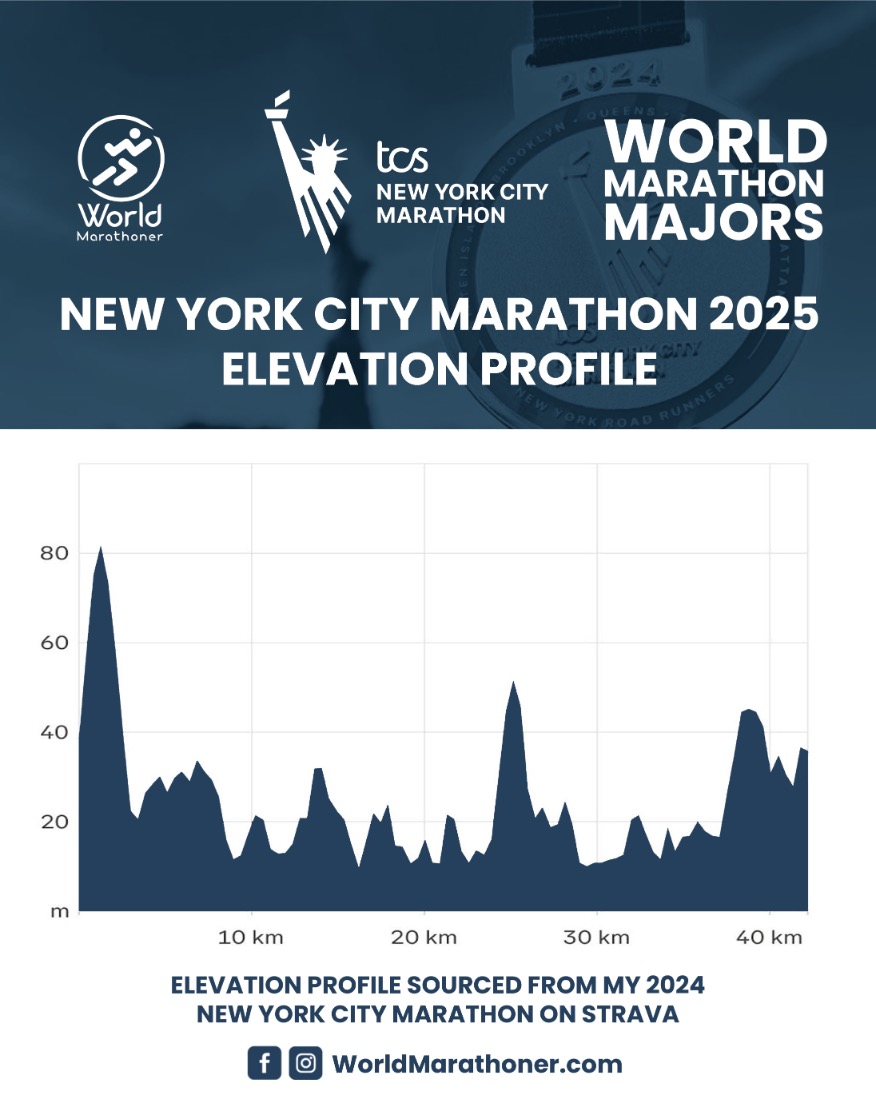
Analyzing the NYC Marathon course profile makes one thing clear: this is not a flat race. It’s a strategic challenge that runs through five boroughs, filled with bridges and undulating terrain. The elevation chart shows constant changes in gradient, with no long, flat stretches.
The key difficulties are not so much steep climbs, but their number and placement. The course accumulates fatigue through five bridges and a series of hills in the crucial, final stage of the race. Smart pacing is absolutely critical here.
The Start: The Biggest Climb (0-3 km / Miles 0-2)
The race begins immediately with its most technically challenging climb: the Verrazzano-Narrows Bridge. As seen on the profile, this is the highest point of the entire course. The ascent lasts for over a kilometer (about 3/4 mile), with an average gradient of around 4%. The starting adrenaline can be misleading; starting too fast here is a classic mistake. The downhill on the other side is just as long—it should be used for recovery, not for making up time.
The Middle Section: Brooklyn and the Bridges (5-26 km / Miles 3-16)
After descending the bridge, the course leads through Brooklyn, where the crowd support is incredible. However, be cautious around mile 8 (13 km), where the three starting corridors merge, often causing bottlenecks and slowing the pace. Until the halfway point, the route is relatively gentle.
The challenges return around the halfway mark. First, the short Pulaski Bridge (leading to Queens), and shortly after, at mile 15 (approx. 24 km), the infamous Queensboro Bridge. This is a long, steady climb (over 800 meters) in complete silence, with no spectators. It’s a tough mental test just before entering Manhattan and the “wall of sound” on First Avenue.
The Bronx and Return to Manhattan (26-35 km / Miles 16-22)
First Avenue is flat and fast, and the energy from the crowds carries the runners. After mile 19 (approx. 31 km), there’s a short “jump” into the Bronx via the Willis Avenue Bridge. This section is quick, with a few tight turns, before the course returns to Manhattan via the Madison Avenue Bridge. These two bridges are just minor “bumps” on the profile compared to the earlier challenges.
The Finale: 5th Avenue and Central Park (36-42.2 km / Miles 22-26.2)
The real marathon begins around mile 22.5 (36 km). This is where the course hits the long, dragging climb up 5th Avenue (visible on the profile as the long, gradual rise before 40 km). The gradient is “only” about 2%, but after this distance, it feels like a steep mountain. This is where many runners experience their biggest crisis.
Entering Central Park doesn’t mean the challenge is over. The last 3 km are undulating, with a series of short, sharp hills (“rollers”). The course briefly leaves the park before returning for the final meters. The finish line itself is also on a slight incline.
See Also
The course profile is one thing, but to fully understand the race, check out my NYC Marathon 2025 course guide, which also describes logistics and aid stations.
Understanding the start logistics is also key. See our guide on how the wave start system works in New York.
Dreaming of running, but don’t have a qualification or lottery luck? Check out what guaranteed entry through New York Road Runners philanthropy entails.
And at the finish line, a reward awaits. See the official NYC Marathon 2025 finisher medal and the entire finisher collection from New Balance.
FAQ – NYC Marathon Course Profile
What is the hardest climb on the course?
Technically, the hardest (highest and steepest) is the first bridge, the Verrazzano-Narrows, right at the start. However, mentally and physically, two other sections are tougher: the Queensboro Bridge (around 24 km) due to its length and silence, and the 5th Avenue climb (around 36-37 km) because it comes so late in the race.
Is this a good course for a personal best (PB)?
Generally, no. Due to the undulating profile, numerous bridges, and a tough finish, the NYC course is considered one of the slower World Marathon Majors. This is a race you run for the experience and atmosphere, not necessarily for a personal best.
How many bridges are on the course?
The course crosses five main bridges: Verrazzano-Narrows (start), Pulaski Bridge (to Queens), Queensboro Bridge (to Manhattan), Willis Avenue Bridge (to the Bronx), and Madison Avenue Bridge (back to Manhattan).
Is the finish in Central Park flat?
No. The last 2-3 kilometers (approx. 1.5-2 miles) in Central Park are undulating. The path winds, offering short but noticeable “rollers” (uphills and downhills), and the finish line itself is on a slight incline.