New York City Marathon 2025 – Course Guide
On Sunday, November 2, 2025, the 54th edition of the TCS New York City Marathon will take place – one of the world’s most iconic marathons and part of the Abbott World Marathon Majors series. On this day, tens of thousands of runners from around the globe will tackle the legendary 26.2-mile (42.195 km) course, which runs through all five boroughs of New York City: Staten Island, Brooklyn, Queens, the Bronx, and Manhattan.
This event is a true celebration of running, attracting millions of spectators to the streets of the Big Apple. The course is famous not only for its incredible atmosphere and crowd support but also for its challenging profile, full of bridges and hills, which tests even the most experienced runners. Finishing in Central Park is every marathoner’s dream.
Start Timeline
| Event | Time (ET) |
|---|---|
| Professional Wheelchair Division (Men) | 8:00 a.m. |
| Professional Wheelchair Division (Women) | 8:02 a.m. |
| Handcycle Category and Select Athletes with Disabilities | 8:22 a.m. |
| Professional Women’s Open Division | 8:35 a.m. |
| Professional Men’s Open Division | 9:05 a.m. |
| Wave 1 | 9:10 a.m. |
| Wave 2 | 9:45 a.m. |
| Wave 3 | 10:20 a.m. |
| Wave 4 | 10:55 a.m. |
| Wave 5 | 11:30 a.m. |
Course Organization and Time Limits
The TCS New York City Marathon course is closed to vehicular traffic during the race. However, streets will reopen on a rolling basis as runners pass. The schedule of closures and reopenings will be available closer to the event date.
Organizers expect runners to maintain a pace of approximately 16 minutes per mile (approx. 10 min/km), calculated from the start of the final, fifth wave. Participants unable to maintain this pace should be aware that aid stations and other on-course amenities may become unavailable. These runners may be asked to move to the sidewalk or board the “sweep bus” that follows the last runners.
Official Results and Finisher Status:
- Official finishers will be recorded until 10:00 p.m. (ET), regardless of their start time.
- Those who finish by this time will receive a finisher medal, an official result, and (if applicable) credit for the 9+1 program or a star in the Abbott World Marathon Majors program.
- Participants crossing the finish line after 10:00 p.m. will receive a medal but will not be listed in the official results.
Sweep buses will pick up participants who choose to drop out of the race and transport them to the finisher area (without the ability to cross the finish line).
Aid Stations and Medical Support
You will find extensive support on the New York City Marathon course. For your safety, please use only the official stations.
Fluids and Food:
- Purified Water: Available at official stations every mile, from mile 3 to 25 (except miles 5, 7, and 9).
- Gatorade® Endurance Formula™ (Lemon-Lime): Available at the same locations as water (miles 3-25, except 5, 7, 9).
- Maurten Gels: Two gel stations will be available – at mile 12 and mile 18. Maurten Gel 100 (non-caffeinated) and Maurten Gel 100 Caf 100 (caffeinated) will be provided. The number of gels is limited, so bringing your own supply is recommended.
- Bananas: Available around mile 21.
Medical Aid and Toilets:
- Portable Toilets: Located at every hydration station (every mile, starting from mile 3), including wheelchair-accessible units.
- Medical Aid: Medical stations are located approximately every mile (from mile 3) and at the finish. Medical teams are equipped with AEDs. For medical emergencies on the course, call the dedicated emergency number: 866.705.6626.
- Lactation Accommodations: Dedicated lactation spaces will be available on the course (miles 8, 17, 22), equipped with manual breast pumps.
Course Profile – Bridges and Hills
The New York course is not one of the easiest and is certainly not flat. The total elevation gain is approximately 870 feet (265 meters). The key challenges are the bridges connecting the boroughs and the final stretch in Central Park.
- Verrazzano-Narrows Bridge (Start, Miles 1-2): The largest climb on the course (approx. 157 ft / 48m). The first mile is uphill. Since the start is crowded, most runners take it slow, which helps conserve energy.
- Lafayette Avenue (Miles 8-8.5): A long, gradual incline in Brooklyn (approx. 59 ft / 18m).
- Pulaski Bridge (approx. Mile 13.5): A short but noticeable climb (approx. 39 ft / 12m) connecting Brooklyn and Queens.
- Queensboro Bridge (Miles 15-16): Considered by many to be the most mentally challenging section. A long (approx. 0.55 miles / 0.9km) climb with a 3% grade (total gain 102 ft / 31m). It’s quiet (no spectators on the bridge), and runners are already past the halfway point.
- Willis Avenue Bridge (approx. Mile 20): A short (approx. 39 ft / 12m) but painful climb just before “the wall,” leading into the Bronx.
- Fifth Avenue (Miles 23-24): A long, dragging incline (approx. 0.9 miles / 1.4 km, 102 ft / 31m gain) leading to Central Park. It’s not steep, but at this stage of the marathon, it is extremely demanding.
- Central Park (Final 2 miles): The course in the park is rolling. Short, but sometimes steep (over 4%) “rollers” test your remaining strength.
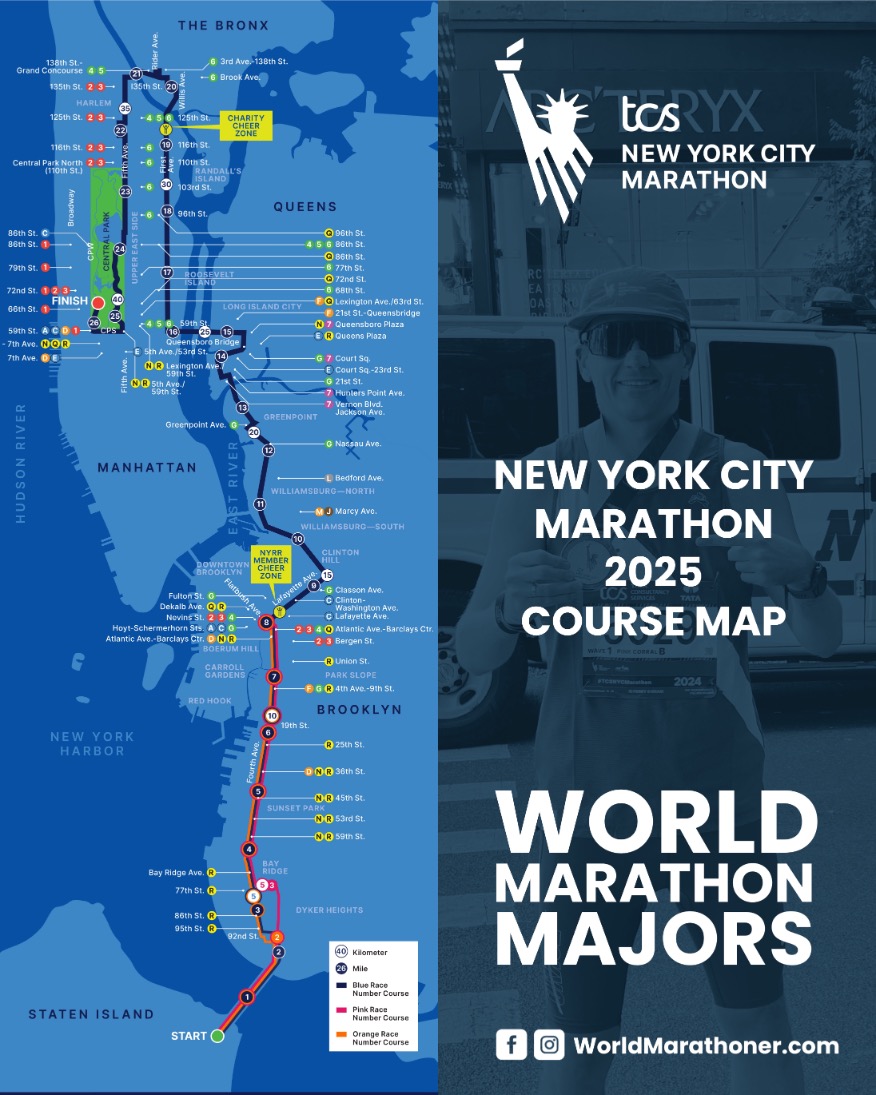
Course Tour Through the 5 Boroughs
The NYC Marathon course is a true tour of the metropolis.
- Staten Island (Miles 1-2): The start on the Verrazzano Bridge. These are the only miles in this borough. Runners are split into three routes (Blue, Orange, Pink), which later merge in Brooklyn.
- Brooklyn (Miles 3-13): The longest stretch of the marathon. After descending from the bridge, the course runs along 4th Avenue, then Lafayette Avenue and Bedford Avenue. These are flat, wide avenues with incredible crowd support.
- Queens (Miles 13-15): After crossing the Pulaski Bridge, runners spend a short time in Queens before heading onto the ominous Queensboro Bridge.
- Manhattan (Miles 16-19): Descending from the Queensboro Bridge onto First Avenue is one of the most exciting moments – the “wall of sound” from the crowds carries runners through the next miles.
- Bronx (Miles 20-21): A short “jump” over the Willis Avenue Bridge into the Bronx. This is a tough psychological moment, but the crowd support helps conquer this section before returning via the Madison Avenue Bridge back to Manhattan.
- Manhattan / Central Park (Miles 22-26.2): The final act. A run through Harlem, the tough climb up Fifth Avenue, and finally, entering Central Park for the rolling finish. The finish line is located near Tavern on the Green.
See Also
The course itself is one thing, but understanding the start logistics is also crucial. See our guide on how the start wave system works in New York to know what to expect in the start village.
Dreaming of running but didn’t get in through the lottery or with a qualifying time? There’s another way. Check out what guaranteed entry through New York Road Runners philanthropy involves and how you can help while achieving your dream.
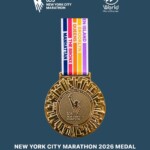
And at the finish line, a reward awaits that makes all the effort worthwhile. See what the official 2025 NYC Marathon finisher medal looks like – a symbol of conquering one of the greatest courses in the world.
Summary: Prepare for the Challenge
The New York City Marathon is not a flat race. It’s a course that tests your character. From the loud streets of Brooklyn, through the quiet and difficult Queensboro Bridge, to the grueling climb up Fifth Avenue and the rolling hills at the end in Central Park – this marathon is the essence of running through a metropolis. The key is to pace yourself wisely, not to chase a PR from the first mile on the Verrazzano Bridge. Regardless of your time, the energy of this city and the sight of the finish line in Central Park make every struggle on the course worthwhile.
FAQ – NYC Marathon Course
Where are the aid stations?
Official stations with water and Gatorade are located every mile, starting from mile 3 (except miles 5, 7, and 9).
What gels are on the course and where?
Organizers provide Maurten energy gels (Gel 100 and Gel 100 Caf 100) at two points: mile 12 and mile 18.
What is the time limit to finish the marathon?
Official results will be recorded for runners who cross the finish line by 10:00 p.m. “Sweep buses” follow the course at approximately a 16 min/mile pace (from the last wave start), picking up runners who fall behind the limit.
Where are the toilets?
Portable toilets (including wheelchair-accessible units) are located at every hydration station, meaning every mile from mile 3.
Are there accommodations for nursing mothers on the course?
Yes, there will be dedicated lactation spaces at three points on the course: mile 8, mile 17, and mile 22.