
Starting the New York City Marathon requires some advance planning, from arranging transportation to checking your assigned wave and preparing the right gear. Runners set off from Fort Wadsworth on Staten Island, with participants divided into five waves, three start colors and six corrals. In this article, I cover the key details of the start, including start times, the organization of the start village, transportation options, baggage rules and items that are permitted or prohibited.
Marathon Start Times
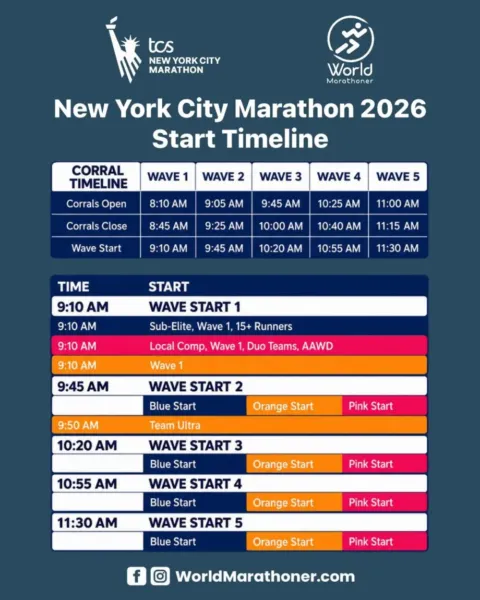
The event begins with the wheelchair divisions and handcycle athletes, followed by the elite women and men. The remaining runners then set off in successive waves. The five general start waves are scheduled 35 minutes apart.
| Division | Start Time (ET) |
|---|---|
| Professional Wheelchair Division – Men | 8:00 AM |
| Professional Wheelchair Division – Women | 8:02 AM |
| Handcycle and Select Para Athletes | 8:22 AM |
| Professional Women | 8:35 AM |
| Professional Men | 9:05 AM |
| Wave 1 | 9:10 AM |
| Wave 2 | 9:45 AM |
| Wave 3 | 10:20 AM |
| Wave 4 | 10:55 AM |
| Wave 5 | 11:30 AM |
All times are listed in New York local time (ET). Daylight Saving Time ends overnight from October 31 to November 1, 2026. At 2:00 AM, clocks move back one hour, giving runners an extra hour of sleep. Most phones and watches adjust automatically, but it is worth checking your device settings.
Your assigned wave, start color, corral and start time are available through your NYRR Dashboard and on your race bib. I have also covered the other practical details of the start in a separate article: New York City Marathon 2026 start arrangements.
Start Colors and Wave Organization
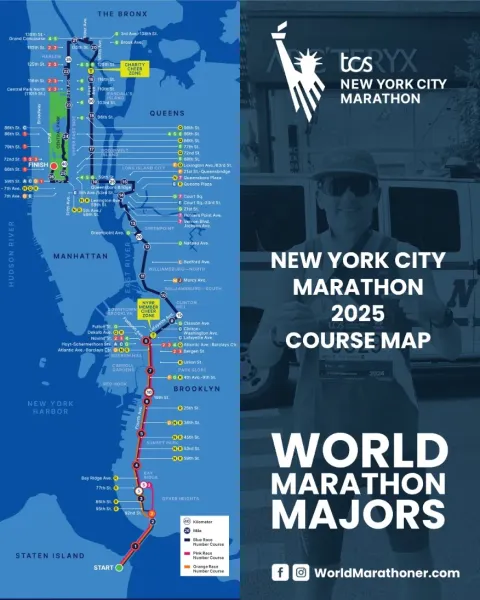
Each wave is divided into three separate start groups: Blue, Orange and Pink. Your assigned color determines where you begin on the Verrazzano-Narrows Bridge. Blue runners start on the right side of the upper deck, Orange runners on the left side of the upper deck, and Pink runners on the left side of the lower deck. The Blue and Pink routes merge at approximately mile 3.2. Orange runners follow a separate section along the left side of Fourth Avenue before all three groups come together around mile 8.

From approximately mile 2.4, Blue and Orange runners continue along Fourth Avenue in Brooklyn. Pink runners join this section around mile 3.2. Until approximately mile 8, Orange runners remain on the left side of the road, while Blue and Pink runners use the right side. Participants must not cross between the designated sections before the groups officially merge.
Each color group has six corrals, marked A through F. These are the designated areas where runners gather before moving towards the start line. Once the corrals are released, participants line up in one larger group for their assigned color. Runners from corral A move out first and take the front positions, while those from corral F line up at the back. Toilets are also available inside the corrals.
Wave and corral assignments are based on a runner’s estimated finish time or NYRR Pace, if they have previously completed an NYRR race. The fastest participants are assigned to Wave 1, with the remaining runners placed in Waves 2–5. Within each wave, participants are grouped by pace across corrals A, B, C, D, E and F.
Differences Between the Blue, Orange and Pink Routes
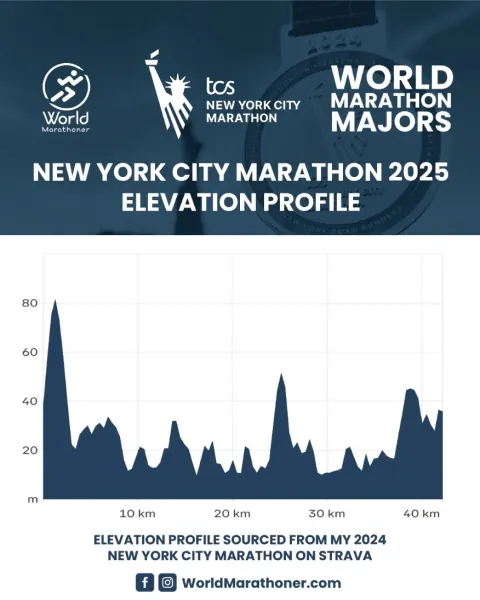
The first 3.2 miles differ depending on the assigned start color, with variations in elevation and turns. The Pink route has the least elevation gain and includes four 90-degree turns. Blue has approximately 30 feet (9 meters) more elevation gain than Pink and includes two such turns. Orange has approximately 50 feet (15 meters) more elevation gain than Pink, along with four 90-degree turns.
Starting on the lower deck of the bridge in the Pink group does not necessarily mean a worse view. The overall perspective is similar, although runners do not have the same direct view above them. Rumors about unpleasant interactions between runners on the upper and lower decks should not be treated as fact. Your start color is determined by your official assignment, and runners should follow the instructions provided by the organizers.
Changing Your Corral or Wave
Your assigned wave and corral are shown on your official race information. Runners may move to a later, slower wave or corral, but they cannot move to an earlier, faster start. Starting in a group earlier than the one assigned may result in disqualification and could lead to suspension from future NYRR events.
If two runners with different assignments want to start together, they should line up in the later wave and corral. For example, a Blue runner may move to Orange or Pink in the same corral or a later one. They may also choose any corral in a later wave. An Orange runner may move to Pink in the same or a later corral, or join a later wave. A Pink runner may move to a corral with a later letter or to a subsequent wave. Moving to an earlier start is not permitted.
Corrals close before the start of each wave. Runners who arrive after their assigned corral has closed cannot enter it and must wait for further instructions from race staff. Pay attention to announcements and follow directions from the organizers.
Getting to the Start Area at Fort Wadsworth
Official transportation to the start is available to participants who selected the relevant option during registration. Capacity is limited, and seats are allocated on a first-come, first-served basis. To avoid problems on race morning, use the transportation option assigned during registration. The organizers ask runners not to change their selected option independently.
| Transportation Option | Departure Point | Additional Information |
|---|---|---|
| Staten Island Ferry | Whitehall Terminal, Manhattan | Several MTA subway and bus lines serve the terminal. The free ferry takes runners to St. George Terminal on Staten Island, where free shuttle buses transport participants to Fort Wadsworth. |
| Midtown Manhattan Bus | New York Public Library, Fifth Avenue at 40th Street | Buses travel directly to Fort Wadsworth. The library is centrally located and accessible via several MTA subway and bus routes. |
| New Jersey Buses | MetLife Stadium, Parking Lot K, near the Quest Diagnostics Training Center | Buses take participants directly to Fort Wadsworth. There is no participant parking at the departure point. |
| Midtown Ferry | Pier 79, 12th Avenue and West 39th Street | The ferry takes runners from the area near the Javits Center to Homeport Pier. Shuttle buses then transport participants from Homeport Pier to Fort Wadsworth. This option is available only to selected participant groups. |
Estimated Travel Times to Fort Wadsworth
| Transportation | Approximate Travel Time |
|---|---|
| Staten Island Ferry / Shuttle Bus | 30 minutes |
| Midtown Manhattan Bus | 90 minutes |
| New Jersey Bus | 60 minutes |
| Midtown Ferry | 60 minutes |
These estimates do not include security screening. Allow extra time for security checks, using the toilets, dropping off unwanted clothing and making your way to the assigned corral.
Start Village Access and Amenities
Access to Fort Wadsworth and the start area is restricted to registered participants and their guides. Your race bib must be visible during the entry screening, and its color identifies your assigned start village. More than 1,600 toilets will be available across the start villages and corrals. Medical staff will also be on site. If you feel unwell, contact a member of the medical team.
The start villages will offer a range of refreshments and products from event sponsors, while supplies last. These include Dunkin’ coffee, tea, hot chocolate, water, Gatorade Endurance Formula and bagels. Other facilities and services include the Zen Zone relaxation area, a sensory space, interfaith and non-denominational services, a Jewish minyan, a nursing station and therapy dogs. Electronic waste collection points will also be available. Portable chargers and other electronic waste should be handed in at the designated stations rather than placed in regular bins.
The organizers recommend wearing extra layers to stay warm before the race. Unwanted clothing can be left in designated collection bins. All collected clothing will be donated to All of Us.
Bags and Baggage Rules
Only bags approved by the organizers may be brought into Fort Wadsworth and the finish area. The only bag permitted in the start village is the official clear Start Village Bag distributed at the Expo. Regular backpacks and other bags are not allowed at Fort Wadsworth or on the Verrazzano-Narrows Bridge, subject to the specific exceptions for hydration equipment. All bags may be inspected. There is no option to drop off a bag at the start and have it transported to the finish.
Each runner may use the official Start Village Bag for belongings they want to keep with them in the start area. All items must fit inside the bag. Any belongings that runners do not intend to take onto the course must be removed before leaving the corral. The organizers do not transport Start Village Bags to the finish line.
Participants who selected the Pre-Check Bag service during registration must place their belongings in the designated bag. The Pre-Check Bag drop-off point will be located on Central Park West, between West 74th Street and West 75th Street. Bags can be dropped off on Friday, October 30, and Saturday, October 31, from 9:00 AM to 5:00 PM. Registration for this service closed on September 8. It is available only to runners who selected it in advance. There will be no opportunity to check a bag for transport to the finish on race morning.
Items Permitted on Race Day
The table below summarizes the items permitted by the organizers. These include selected hydration equipment, official bags and a few small accessories that may be useful during the event. All items must meet the specified requirements.
| Category | Permitted Items |
|---|---|
| Hydration | Waist belts with bottles, handheld bottles, clear disposable bottles with a capacity of up to 1 liter, and hydration vests fitted only with front bottles holding up to 1 liter each. Vests that also have a rear bladder or reservoir are permitted only if the reservoir remains empty and is not used during the event. |
| Official Bags | The official Start Village Bag for use in the start area, and bags approved for the Pre-Check Bag service if the participant selected this option in advance. |
| Other Items | Unfolded small blankets, jackets, Mylar thermal blankets, and small clear tarps or sit-upons measuring less than 10 square feet. |
Prohibited Items on Race Day
The organizers impose restrictions on bags, containers, sporting equipment and other items that could pose a risk to participants or disrupt the event. The table below brings together the main categories of prohibited items at the start area and during the race.
| Category | Prohibited Items |
|---|---|
| Substances and Animals | Alcoholic beverages, illegal substances and animals. |
| Backpacks and Hydration Packs | Any bag not included on the permitted-items list. This specifically includes backpacks and hydration vests with rear bladders or water reservoirs, as well as liquid containers larger than 1 liter, including hydration systems, vests and belts fitted with such containers. |
| Shoulder Bags | Backpacks, handbags and similar items carried over the shoulder, regardless of size. |
| Bags for Finish-Line Transport | Bags other than those specifically listed as permitted, including opaque bags and non-clear plastic bags. |
| Suitcases and Wheeled Devices | Suitcases, wheeled bags, bicycles, roller skates, inline skates, scooters, skateboards, strollers and other unauthorized wheeled devices. |
| Containers | Certain containers, including coolers and other containers capable of holding more than 1 liter of liquid, as well as glass containers. |
| Tobacco Products and Electronic Devices | Cigarettes, tobacco and tobacco products, cannabis and cannabis products, vaping devices and other electronic smoking devices. |
| Items That May Disrupt the Event | Confetti launchers, flags, air mattresses, portable speakers, tents and freestanding structures, video cameras and weights of any kind, including weighted vests. |
| Costumes and Equipment | Costumes that cover the face and loose-fitting outfits that extend beyond the runner’s body. Comforters, sleeping bags, large blankets and picnic blankets, as well as folding chairs and tables, are also prohibited. |
| Potential Weapons | Firearms, knives, sticks, rods, clubs and other objects that could be used as weapons. This also includes sharp or blunt objects such as umbrellas, poles, batons, selfie sticks and hammers. |
| Props and Specialized Equipment | Props, including sporting equipment, military and firefighting gear, and signs or flags larger than 11 × 17 inches. Flags attached to poles are also prohibited. |
| Hazardous Materials | Flammable liquids, aerosols, fuels, fireworks, toxic chemicals and explosive materials. |
Hydration Equipment: Important Restrictions
Hydration vests are permitted if they use front-mounted bottles with a capacity of up to 1 liter each. If a vest also has a rear bladder or water reservoir, it must remain empty and cannot be used during the race. Waist belts with bottles and handheld bottles are also allowed. Each bottle may hold a maximum of 1 liter. Regular backpacks and hydration systems with water stored at the back are not permitted.
Pre-Start Checklist
Before leaving for the start, check your assigned wave, start color, corral and start time in your NYRR Dashboard. Prepare your official race bib and make sure it is clearly visible. Use the correct bag and check that its contents comply with the event rules. Plan your journey according to the transportation option selected during registration, allowing enough time for security screening, using the toilets and reaching your assigned corral.
The marathon result is based on chip time, also known as net time. This means your time starts when you cross the start line, not when your wave officially begins.
More About the New York City Marathon
Find more news, practical guides, race information and reports about the New York City Marathon in the dedicated section of World Marathoner.
Explore the New York City Marathon section on World Marathoner →