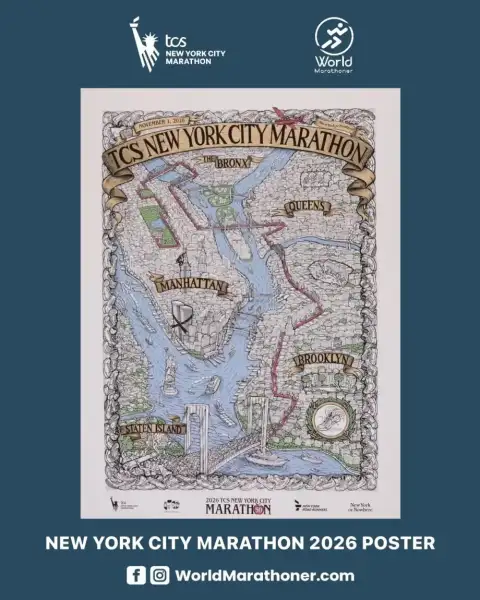

The TCS New York City Marathon 2026 will take place on November 1, 2026. The 26.2-mile course, covering approximately 42.195 km, passes through all five boroughs of New York City: Staten Island, Brooklyn, Queens, the Bronx, and Manhattan. The race starts on Staten Island and finishes in Central Park. One of the most significant features of this year’s race is a change to the course in the Bronx. New York Road Runners is introducing this change for the first time in 15 years, marking the 50th anniversary of the marathon as a five-borough race. Below, you’ll find an overview of the course, key points along each section, and information about hydration, energy gels, and runner facilities.
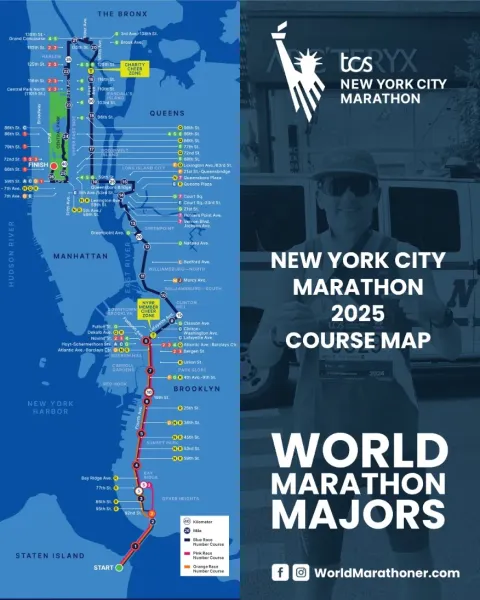
TCS New York City Marathon 2026 Course Map
The interactive map below shows the New York City Marathon 2026 course and its marked points of interest. You can zoom in and move around the map to examine individual sections of the route in greater detail. It’s worth familiarizing yourself with the course before race day, especially if you’re running and want to plan your pacing strategy or choose meeting points with spectators.
If the map doesn’t display correctly on your mobile device, you can open it directly in Google My Maps – TCS New York City Marathon 2026. Detailed organizational information and official materials are available from New York Road Runners (NYRR).
Staten Island – The Start On The Verrazzano-Narrows Bridge
The marathon begins on Staten Island, near the Verrazzano-Narrows Bridge, which takes runners toward Brooklyn. The start is divided into three color-coded routes: Blue, Orange, and Pink. Runners in the Blue and Orange routes use the upper level of the bridge, while those in the Pink route begin on the lower level. During the opening miles, runners should account for the bridge’s incline and the large number of participants. Despite the extraordinary atmosphere, it’s important not to start too fast. A controlled pace early on can help you conserve energy for the second half of the marathon.
Brooklyn – The First Major Section Of The Course
After crossing the bridge, runners enter Brooklyn, which accounts for a substantial portion of the course. Depending on their starting route, runners follow slightly different streets during the opening section. The course then continues along streets including Fourth Avenue before heading toward Flatbush Avenue, Lafayette Avenue, and Bedford Avenue. Throughout the next several miles, runners pass through city streets where spectators create the distinctive atmosphere of the New York City Marathon.
Brooklyn is a good place to monitor your pace and stay hydrated according to your plan. The long stretch may feel relatively easy, especially with enthusiastic crowds cheering you on, but starting too fast can catch up with you after mile 18. Before leaving the borough, runners head toward Queens and the Pulaski Bridge, which is located near the halfway point.
Queens And The Queensboro Bridge
After crossing the Pulaski Bridge, runners enter Queens. The course continues through the borough’s streets before heading toward the Queensboro Bridge. Crossing this bridge is one of the marathon’s signature moments. The climb requires careful effort management, while the descent toward Manhattan can place additional stress on the leg muscles.
After reaching Manhattan, runners make their way toward First Avenue. The surroundings change, and the crowds become particularly loud and enthusiastic. However, it’s important to remember that there is still a considerable distance to cover. Even if you’re feeling strong, managing your energy wisely is more important than speeding up in response to the excitement.
The Bronx – Course Changes After 15 Years
The most significant change to the TCS New York City Marathon 2026 course affects the Bronx. New York Road Runners has decided to modify this section to reduce the event’s impact on the local community and account for changes in this part of the city. This is the first course change in 15 years.
After crossing the Willis Avenue Bridge, runners will turn left onto East 135th Street, then right onto Alexander Avenue. They will continue straight along Alexander Avenue instead of turning onto East 138th Street, as they did under the previous route. Next, they will turn left onto East 141st Street, left again onto Third Avenue, and then right onto East 138th Street. From there, they will head toward the Madison Avenue Bridge, which will take them back to Manhattan.
The change introduces a different street layout in this section, replacing the previous route, which included additional turns around Lincoln Avenue, Morris Avenue, East 140th Street, and Rider Avenue. If you’re using maps from previous editions, make sure they’re up to date before race day. For more information about the reasons for the change and details of the new route, read my separate article: New York City Marathon 2026 – Course Changes After 15 Years.
Manhattan And Central Park – The Final Miles
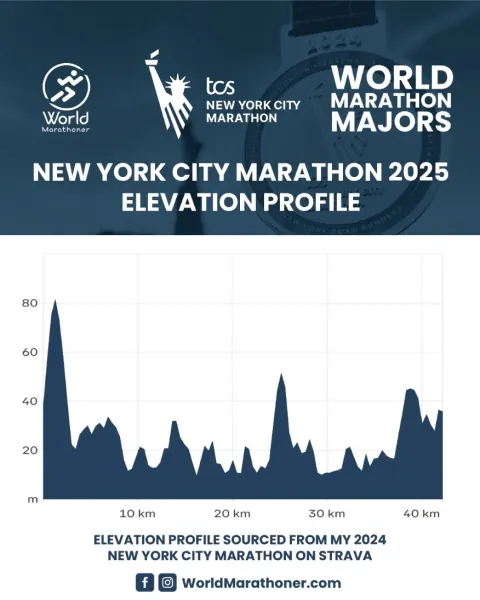
After returning to Manhattan, runners head toward Fifth Avenue and then Central Park. At this stage, fatigue after more than 30 kilometers can have a noticeable effect on pace. The uphill section on Fifth Avenue is worth accounting for in your race plan because it comes relatively late in the marathon. In these circumstances, it’s better to manage your effort than to try to maintain your target pace at all costs.
Central Park isn’t completely flat. The final section includes changes in elevation and short climbs that can feel challenging after a long effort. The course runs through the park, heads toward Columbus Circle, and then returns to Central Park, where the finish line awaits. For many participants, this section is the final test of endurance and commitment to their race plan. Save some energy for the finish rather than assuming the hardest part is over as soon as you enter the park.
Water And Sports Drinks Along The Course
According to the organizer, purified water and Gatorade Endurance Formula in Lemon-Lime flavor will be available at official fluid stations every mile from mile 3 through mile 25, except at miles 5, 7, and 9. Drinks will be served in compostable cups, with tables positioned on both sides of the course. To avoid congestion, you can use a table farther down the station instead of stopping at the first one. After collecting your cup, keep moving and be mindful of the runners around you.
Additional self-service stations offering filtered Culligan water are planned for miles 8, 14, 17, 20, and 23. These may be useful for runners carrying their own bottles or cups. However, it’s worth checking the official map beforehand to see where the stations are located and to adjust your hydration plan to the weather conditions and your individual needs.
Energy Gels And Bananas
Maurten energy gels are scheduled to be available at miles 12 and 18. The options are expected to include Maurten Gel 100 without caffeine and Maurten Gel 100 Caf 100, which contains caffeine. The organizer notes that the number of gels is limited and cannot guarantee availability for every runner. For this reason, runners are advised to bring their own fuel and treat the on-course gels as a supplement to their individual nutrition strategy. The organizer also recommends taking one gel at each station.
Bananas are scheduled to be available at mile 21. Additional Maurten gels can be purchased at the brand’s booth during the TCS New York City Marathon Expo Presented by New Balance. Before race day, stick to products you’ve already tested during training and avoid experimenting with new fueling strategies during the marathon.
Restrooms, Distance Markers, And Timing
Portable restrooms, including accessible facilities for wheelchair users, will be located along the course every mile starting at mile 3. Mile markers will appear every mile, while kilometer markers will be placed every 5 km. Course clocks will be set to the time of the first starting wave, so their readings may not correspond exactly to each runner’s gun time or net time.
Timing mats will be positioned at the start, every mile from mile 3, every 5 km starting at the 5K marker, at the halfway point, at mile 25.2, and at the finish. If you plan to monitor your pace using the course clocks, remember that they reflect the time elapsed since the first wave started, which may differ from your own time measured from when you cross the starting line.
Pedestrian Crossing Zones And Spectator Access
To help spectators move safely around the course, the organizer has designated special pedestrian crossing zones. In Brooklyn, these are located at Lafayette Avenue and Fulton Street, and Bedford Avenue and Broadway. In Manhattan, crossings are planned at First Avenue and 69th Street, 72nd Street, 83rd Street, and 86th Street.
Spectators should plan their viewing locations in advance and check the organizer’s latest guidance. Street closures, large crowds, and traffic restrictions can make it difficult to travel between boroughs. Don’t assume you’ll be able to see a runner at several widely separated points along the course without allowing enough time to get between them.
How To Prepare For The New York City Marathon 2026 Course
Before race day, take time to study the latest course map, paying particular attention to the new route through the Bronx. The bridges, the climbs on Manhattan’s streets, and the changes in elevation in Central Park should all be factored into your pacing strategy. It’s equally important to plan your hydration and fueling, as well as to check the locations of restrooms and fluid stations. The organizer’s information may be updated, so check NYRR announcements about the course and race-day arrangements again before the event.
At World Marathoner, I publish updates about courses, registration, organizational changes, and the latest news related to the New York City Marathon. If you’re preparing to race in New York or following future editions of this event, explore the other articles in this category.
Explore All New York City Marathon Articles On WorldMarathoner.com